


Summary
This is a procedural succulent, with systems allowing each petal to bend, curl, and vary naturally. Parameters such as layer count, jitter intensity, petal size, curvature, and deformation strength are fully customizable, enabling artists to quickly generate diverse plant variations while maintaining full creative control.
Process
For the succument, I started by creating stacked circular layers using a For-Each loop. Each layer was slightly transformed and given random point jitter to give some variations, in order to form a basic structure.
I refined the succulent’s base structure and prepared the points for petal placement. After cleaning and aligning the geometry, I randomized the width, length, and depth of each layer to achieve a more natural look, then adjusted the lift and rotation of each layer to make the petals bend inward.
Then, I assigned a petal ID to each point to manage later instances, and used a line setup and copy to each point to generate the base curves for each petal. These lines serve as growth paths, giving the direction of the petals before shaping begins.
After that, I copied a circle onto each curve point to start shaping the petal cross sections. This created stacked circular layers following the petal paths, setting up the base form for the later polyfill and geometry creation.
Then, I connected and closed the circular cross sections, using polyfill to create a smooth petal geometry. This completed the main body of the succulent.
In the final step, I looped through each petal, isolating them by the petal ID I previously assigned, and applying a bend deformation, allowing each petal to bend and curl individually, giving the succulent a more natural look and some diversities.

Stracked layers (basic structure)

Normal Adjustment and Petal Orientation

Petal Curve Generation

Petal Cross Section Setup

Petal Cross Section Setup
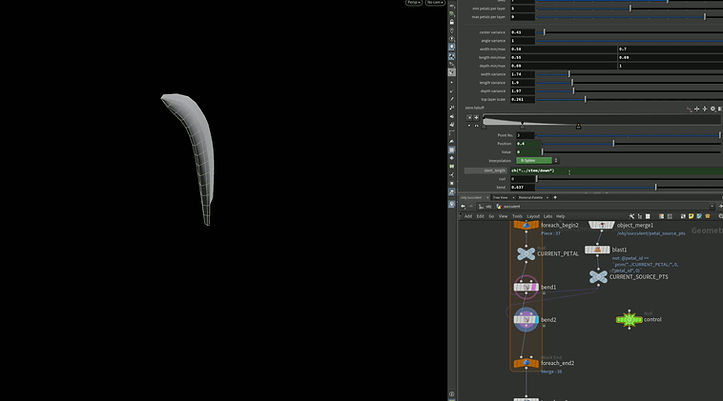
Petal Bending and Curling